


Korea Memorial and Visitor Center Architectural Project:
‘‘ ... When we planted trees with scars on the face of the world Hope as the first buds open in fire-scorched hearts and the dead are able to turn sideways and sleep without resent, knowing that their blood is not wasted peace...'' Yannis Ritsos, Poems: Peace poetry War contains its own contradictions. Like silence and scream, life and death, victory and loss. But in fact, the biggest contrast in war is peace. The more devastating and plundering war is, the more constructive peace is. Peace; It protects people, nature and peace. With peace, nature finds its balance again, the trees grow green, the bitter screams of war are replaced by the chirping of the birds on the branches of the lush green trees. The Turkish soldier who went to the Korean War went to keep the peace. The Korean people's acceptance of their suffering and their struggle to keep the peace showed us the universality of suffering and the truth that peace was the greatest virtue. Our aim in emphasizing peace is to express our gratitude to those who lost their lives for this cause, let alone a little.
DESIGN CONTEXT:
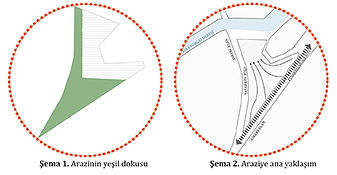
The design area is located in the north of the city of Lüleburgaz and outside the city center. There are many trees in the area between the military areas. (Diagram1) (Diagram2) The first thing visitors encounter when approaching the project area is the dense green tissue formed by trees. It was believed that taking the visitors from the earthly life of the city and preparing them for the spiritual and the spiritual would be through the power of nature and the natural. Nature is associated with peace with its purity, calmness and tranquility. From this point of view, a design approach has been adopted that protects nature and respects the land, the tree and what belongs to nature. All trees in the design area have been preserved, interventions have been made in harmony with the nature of the area and the visitor center structure has found its place in the area. Urban dwellers, who are sometimes deprived of green and sometimes have to make do with limited green areas, have the opportunity to touch the green, smell the green and be in touch with green in the design area
COMMON AREA
While visitors are included in the project area; They take the first steps on their journey from everyday life to the war past. Memorial area; It is a landscape area designed as an open space between the urbanite and the visitor center structure. This area also acts as an interface that prepares visitors for the historical war atmosphere. In the landscape setup, there are stops and pathways connecting these stops that will tell visitors stories of war and allow different emotional experiences. It forms the stops, commemorative walls and the nameplate of martyrs and veterans. (Diagram 3) The commemorative walls contain information about the Korean War and the lived stories of the war. Visitors perform their memorial activities in calmness and peace created by the pure and simple atmosphere of nature.
THE CEREMONY AREA AND THE MONUMENT
The ceremony area is surrounded by the boundaries of the visitor center structure, defined by the upper cover, and positioned to establish a visual relationship with the memorial area. The fact that the ceremony area is located in the semi-open area defined by the visitor center structure has enabled it to establish a relationship with public functions. The ceremonial area turns into a public event space when there is no ceremony and allows for alternative day and night use. Instead of a traditional monument design such as an obelisk or statue; A glass surface design that is close to human scale, can visually integrate with nature due to the transparent nature of the material and will not disrupt the relationship of visitors with nature is proposed. The naturalness, clarity, purity and tranquility of the glass material are harmonized with peace, so this material was preferred in the design of the monument. By making angular surface discharges on the glass surface, the destructiveness of the war and what they have taken away from people are visualized. (Diagram 4) The monumentality in the design is actually the dominance of nature on the land with its intense green atmosphere.
VISITOR CENTER AND SPATIAL ORGANIZATION
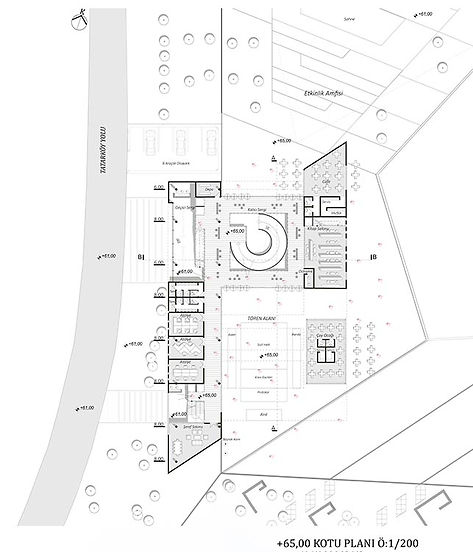
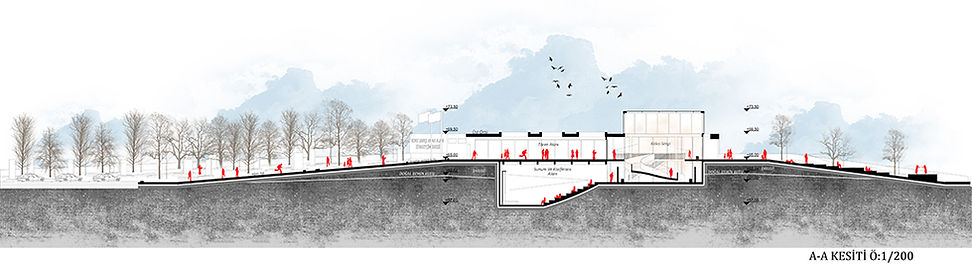
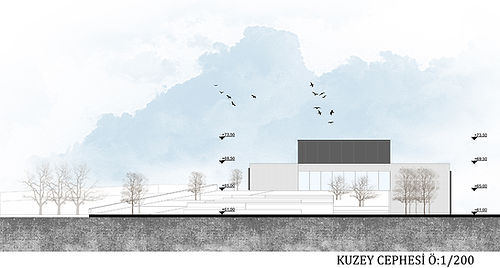
The visitor center structure has been designed in an approach that is compatible with its surroundings, nature and human scale in height and size. The structure, which is located on two levels, takes approach from both roads surrounding the land and attains the height to match with the trees dominating the project area. It takes a humble stance with its non-crushing attitude and takes its place in the field in harmony with nature. (Diagram 5) The project area has a slightly inclined structure. The land reaches 63.52 altitude from 61 elevation by ascending in the northeast direction. The land was raised in this area, a platform at 65 elevation was created and leveling was made in the land. At 65 elevation, there are ceremony area, honor room, tea and coffee hall, book room (the library is at 61 level, while the library is at 61 level, the book room is located at 65 level and its connections with the stairs are provided), workshops and permanent exhibition. The permanent exhibition is solved at two levels and connected by a rotary ramp from 61 to 65 levels. Approaches to the project were taken from Pınarhisar Street (south of the site) and Tatarköy road (west of the site) at 61 elevation. The main approach is taken from Pınarhisar street, one of the main arteries of the city, and directed towards the interior of the building with a topographic arrangement with 6% slope. Thus, visitors seep into both the land and the building. In this way, public continuity was provided between the urbanite and the building. From Tatarköy road, a secondary approach is proposed for protocol entry and visitors. At 61 level, there are administrative spaces, a multi-purpose hall, a workshop area where presentations and exhibition preparations are made on the Korean War, temporary-permanent exhibition and a reading hall.
The permanent exhibition space where objects and documents belonging to the war such as photographs, newspapers, documents, gifts and medals will be exhibited, is connected to a ramp from 61 to 65 and gets natural light from the skylight located in the top cover. The fact that the space receives daylight from the sky is associated with the brightness of hope for peace while in the chaos and darkness of the war. By using the worn texture on the wall surfaces of the space, it is intended to remind the devastating nature of the war. The surfaces of the permanent exhibition space, designed as folding glass at 65 elevation, are folded in periods when climatic conditions are suitable, and the continuity of the public axis formed with the main approach is ensured. Thus, alternative uses have been made possible. (Diagram 6)








GET IN TOUCH:
Tel: +90545 327 43 54
E-mail*
CONTACT US:
Message
Name*


