


A Mosque in Mardin Architectural Project: '' Intersection ''
“Work like someone who thinks she will never die, be cautious like someone who will die tomorrow”
(Camiu’s-Sagîr, II/12, hadis no: 1201)
‘‘Search for the hereafter with the wealth that Allah has given you; also from the world Do not forget your share; How god is good to you If he did, do so well.”
(Kasas, 28/77)
"Work like someone who thinks he will never die, and be cautious like someone who will die tomorrow." The life story that begins with birth is full of endless excitement, joys, expectations and responsibilities for people. Despite the fact that the life of the world is transitory and the life of the hereafter is eternal; He gets so busy with the daily bustle that he gets caught up in the current. However, there is a balance between the worldly and the ethereal in Islam. While walking away from the temporality of the mortal, man suddenly becomes calm with the sound of the call to prayer rising from the earthly noises and remembers the otherworldly and turns towards the truth with a deep silence. It is a place of worship that reminds people of the otherworldly. Based on this, in the project; Mosques, which are places where people turn to the truth and worship in awe, are interpreted as the intersection of the earthly and otherworldly. In this space, human beings interact with the spiritual.
DESIGN CONTEXT:
Design space; It is the city of Mardin, founded on the southern slopes of the hill known as Mazıdağ, overlooking the vast Mesopotamian plain. The city, which has hosted many communities in history, mostly carries the traces of Artuklu architecture. The use of iwans, porticoes and courtyards is striking in the buildings that make up the city. Due to the sloping topography, the buildings exhibit a gradual appearance. This settlement also creates terraces and narrow streets with stairs. The use of limestone, the local material, gives the city a yellow look. The material used in the prayer buildings in the city is cut stone. There are iwans, porticoes and courtyards in worship buildings as well as in residential buildings. In addition, the use of grooved domes in prayer structures draws attention. In the project developed in the light of contextual data; It is aimed to be in harmony with the architectural texture of the city with the use of architectural elements such as gradual settlement, portico and courtyard and local materials.
APPROACH TO LAND:
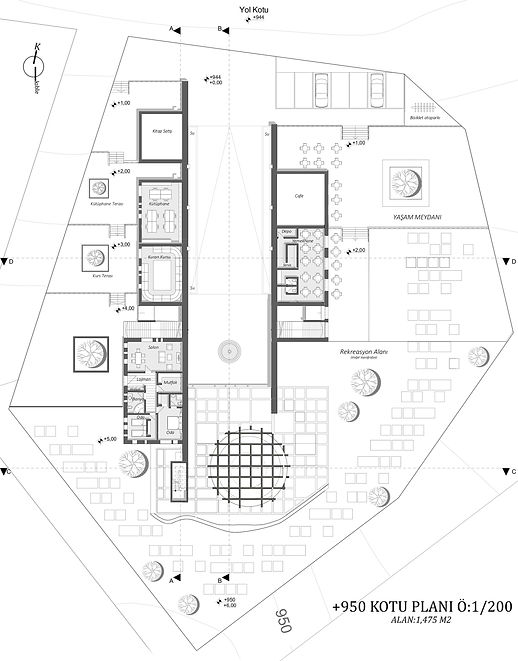
The project land has an inclined structure. While the regions to the north and east of the land are residential, the regions to the south and west contain commercial, educational, health and cultural units. In the project, the main approach to the land is taken from the residential area. At the same time, a secondary approach is recommended by pedestrianizing the road from the area where the education and commercial units are concentrated to the land. Intermediate approaches to the project area are provided from all the streets extending to the land.
THE PLACE OF WORSHIP AND THE DOME
The place of worship is placed at -1.00 elevation (+943 elevation) on the sloping land and buried in the ground and separates from the outside world by creating its own isolated area, however, it continues its interaction with the outer world through the main transition and secondary connections articulated to this main transition. This situation gives the meaning of the place of worship the intersection of the mortal and the eternal. "The front line, if you knew (or knew) (charity), it would be necessary to cast lots." The main prayer area, consisting of men and women, extends along the qibla wall, taking care to keep the front lines wide, as mentioned in the hadith. Worship buildings, which have almost the same architectural language as the residences in the existing urban texture, begin to differentiate from other structures with their grooved domes and rising stone minarets and make them feel like places of worship. The slicing style of these domes, which are unique to the city's worship structures, is abstracted in the project, and a beam system is obtained. This beam system fuses with the natural topography and forms the top cover of the place of worship. (Diagram 10) Thus, the place of worship begins to be perceived from the outside world. Gaps are opened in the upper cover of the place of worship and the place is illuminated by the light beams that seep inside. (Diagram 11) Worship takes place in awe in a dim and spiritual space, free of decoration. On the other hand, the dome of the top cover of the place of worship in the center regulates the acoustics of the interior. The sound rising from the mihrab niche hits the dome, humps are exploited through the gaps on the dome surface and the sound begins to spread to the worship area in its simplest form.




GET IN TOUCH:
Tel: +90545 327 43 54
E-mail*
CONTACT US:
Message
Name*


